How to Improve Hospital Utilization Management

Hospital utilization management (UM) has always been about ensuring that the right care occurs at the right time and for the right patient. But in today’s healthcare landscape, it has also become a frontline defense against rising payer denials and revenue loss. As denials climb and decisions are powered by AI tools that make instant snap judgments, improving hospital utilization management is no longer optional. It’s time to upgrade your hospital utilization management tools to make a measurable revenue impact.
Every denied claim is revenue lost, and traditional, outdated UM solutions leave hospitals defenseless.
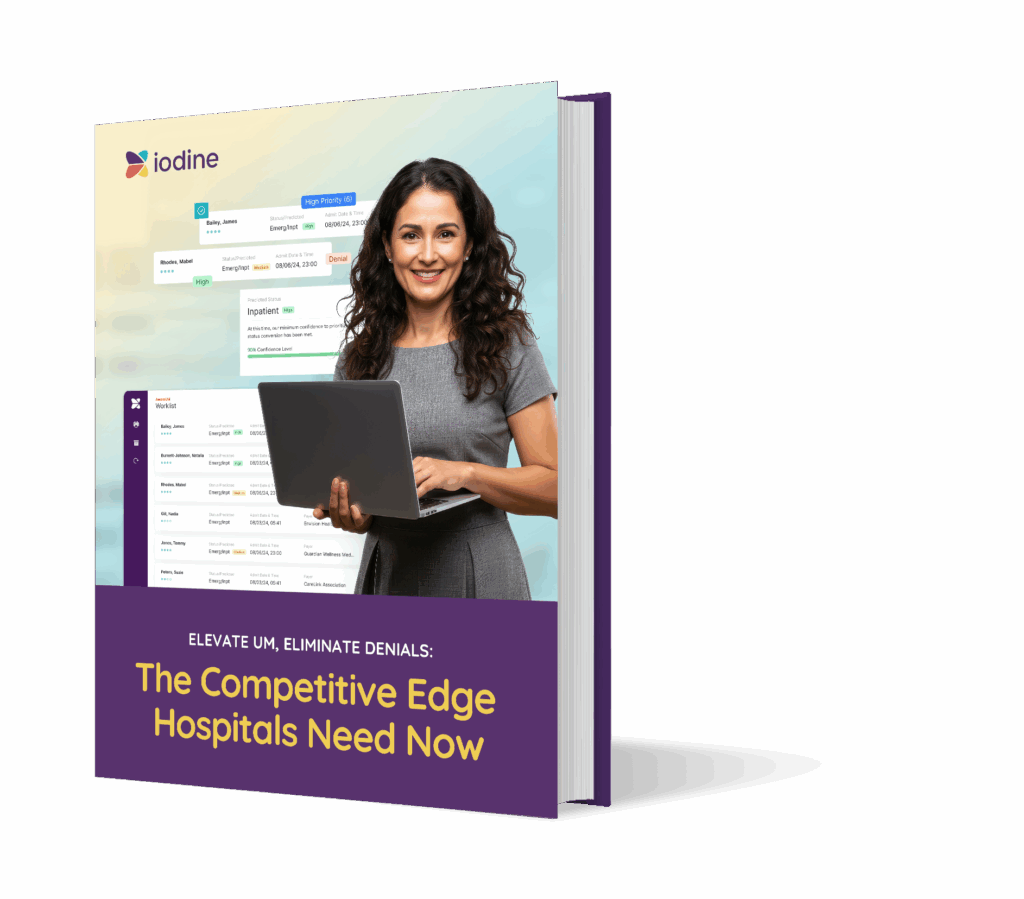
Looking for a breakdown of the signs that may indicate your hospital utilization management processes have broken down?
Download the complete eBook.
What’s Changed in Hospital Utilization Management? Not Much—That’s the Problem.
The truth is, not much has changed in hospital utilization management over the years, but denials are increasing drastically. That’s where the problem arises. Hospitals are reporting higher denial rates than ever, with 89% reporting significant denial increases in recent years. Each denial doesn’t just impact reimbursement; it drives up administrative costs, delays cash flow, and consumes valuable clinical time on appeals.
The cost of fighting denials exceeds $25 billion annually, primarily due to labor costs.
Medicare Advantage has amplified these issues. With enrollment surpassing 50% of eligible Medicare beneficiaries, hospitals are now dealing with stricter pre-authorization rules, inconsistent adherence to CMS guidance, and denial rates up to three times higher than traditional Medicare. Plus, commercial payers are equally aggressive, leveraging AI to scrutinize every line of a claim in milliseconds.
Outdated UM is Causing Revenue Leakage
Traditional utilization management often depends on patchwork workflows across EHRs, spreadsheets, and payer portals. UM nurses are forced to manually review cases without real-time prioritization, while payers’ automated systems run 24/7 with constantly shifting rules. This mismatch leads to:
- Incorrect status assignments (observation vs. inpatient) that impact reimbursement.
- Missed inpatient-only procedures, which drive self-denials.
- Backlogs of reviews after weekends or holidays that create costly delays.
- Burnout and staffing shortages, leaving hospitals without enough UM expertise.
Every missed conversion or delayed review can swing thousands of dollars per patient encounter. Without modernization, these revenue leaks accumulate into significant financial strain.
Modern Healthcare Requires Modern Solutions
Improving hospital utilization management starts with recognizing UM as critical financial infrastructure—not just a compliance checkpoint. Just as payers have embraced AI to deny claims, hospitals can use AI to defend against revenue loss. AI-enhanced UM can:
- Predict which cases are most likely to be denied.
- Flag status changes or missing documentation in real time.
- Automate portions of the appeals process to reduce labor costs.
- Prioritize reviews so staff focus on the highest-risk encounters.
Even a small 2-3% reduction in denial rates can translate into millions of dollars in margin improvement for a hospital system.
Redefining Compliance with AI and Automation
Hear how R1 and Iodine are simplifying compliance— and helping organizations outperform peers.
IodineUM: Fight Denials with AI-Enhanced Solutions
IodineUM is a next-generation solution that leverages machine learning, natural language processing, and large language models to transform how hospitals manage patient status, documentation reviews, and revenue capture.
The platform continuously analyzes the full patient record, flagging status gaps and surfacing a ranked list of high-risk cases based on payer rules and clinical context. This ensures staff can focus on the reviews with the greatest financial impact, supported by prediction transparency, relevant clinical context, and AI-generated summaries. IodineUM also fosters seamless collaboration between UM, CDI, and physicians, creating tighter feedback loops that improve documentation quality and patient outcomes.
By guiding accurate status assignments, preventing administrative denials, and accelerating appeal cycles, IodineUM empowers hospitals to protect revenue integrity while easing the burden on staff. Review times can be cut by more than half, enabling teams to work smarter, stay ahead of payer scrutiny, and ultimately deliver better financial and clinical outcomes.
Plus, it’s all powered by IodineIQ, our proprietary Clinical Intelligence Engine trained on more than one-third of all U.S. inpatient cases.
Ready to Upgrade Your Hospital Utilization Management Tools?
Hospitals that haven’t updated their utilization management infrastructure in the past few years are likely already falling behind. Denials are designed, not accidental, and payer technology will only get faster and more complex. To compete, hospitals need UM processes that are equally advanced, scalable, and proactive.
Redefining Compliance with AI and Automation
Hear how R1 and Iodine are simplifying compliance— and helping organizations outperform peers.
Improving hospital utilization management is one of the most powerful steps health systems can take to protect their financial future. With modern, AI-enabled UM processes, hospitals can stop revenue leakage before it starts—and keep resources focused where they belong: on patient care.